


Fighting wildfires across steep mountain ridges, dense timber, and rocky canyons is fundamentally different from connecting to a city hydrant. When frontline attack crews hike miles into remote backcountry terrain carrying heavy tools, portable pumps, and line coils on their backs, every single ounce directly impacts operational stamina. Every ounce counts.
Weight matters.
That is why selecting the right wildland fire hose requires balancing pack weight, abrasion resistance, and kink tolerance. Deploying heavy municipal lines on a steep mountain slope exhausts frontline crews within minutes. Speed saves lives. Seconds matter.
Here is what procurement officers and wildland teams must know when specifying a dependable forestry fire hose for rugged terrain.
Pack Weight vs Durability: What Sets Wildland Hose Apart
A standard municipal structural line is far too heavy for mountain pack operations. A traditional 100-foot double-jacket hose easily weighs over 30 pounds dry. Far too heavy.
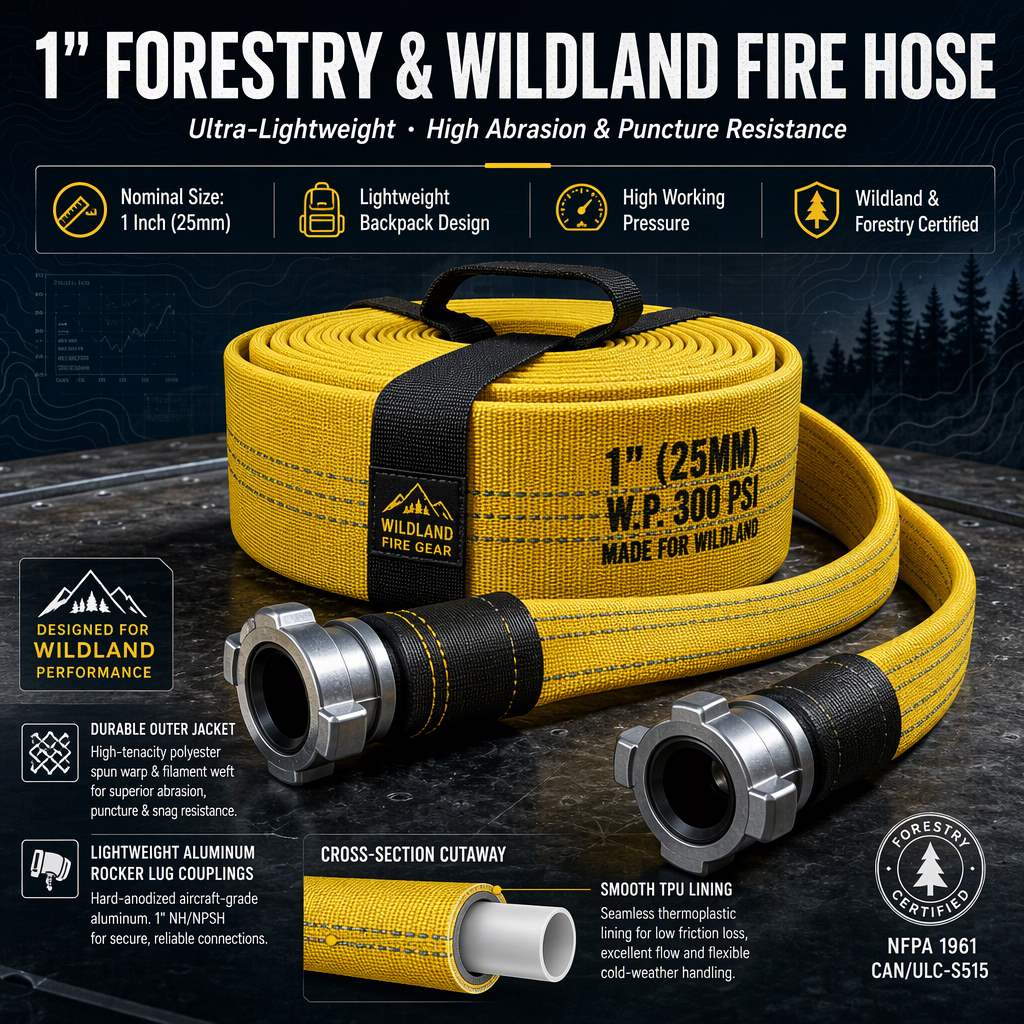
In contrast, modern wildland fire hoses rely on high-tensile polyester single-jacket construction bonded to an ultra-thin TPU liner. As discussed in our review of hose material construction, TPU liners deliver exceptional puncture strength without adding dead weight.
This specialized build allows a 100-foot wildland fire hose section to weigh under 10 pounds. Firefighters can carry multiple coiled lines inside backpack harnesses up steep switchbacks without collapsing from sheer exhaustion. Premium forestry fire hose jackets also receive synthetic polymer coatings that resist hot embers, oil spills, and sharp granite edges. Choosing a resilient forestry fire hose keeps attack lines intact when dragging across burnt ground. Every frontline fire hose must withstand intense thermal radiant heat.
Standard Diameters: Why the 1 Inch Forestry Fire Hose Dominates
Wildland crews deploy progressive hose lays to establish containment perimeters along active fire flanks:
- 1.5 Inch Wildland Hose: Serves as the main trunk supply line advancing directly from portable pumps or tactical tenders.
- 1 Inch Forestry Fire Hose: The undisputed workhorse for direct attack and mop-up operations. As detailed in our guide to line diameter specifications, a 1-inch line flows 15 to 30 GPM with minimal water weight, allowing a single nozzle operator to navigate thick brush effortlessly. Agility is everything.
- 3/4 Inch Forestry Lines: Ideal for lightweight booster reels and low-volume perimeter mop-up.
Every working wildland fire hose must withstand dragging through burning roots and abrasive ash. A tough fire hose prevents sudden pressure blowouts in dense brush. If your fire hose tears on jagged rock, containment fails instantly.
Managing Friction Loss and Elevation Pressure
Pumping water uphill against gravity creates massive hydraulic resistance. Every 100 feet of vertical climb adds roughly 43 psi of backpressure on your portable pump.
Elevation hurts pressure.
As explored in our guide to section length and friction loss, friction loss climbs rapidly in smaller line diameters. When pumping through several hundred feet of a 1 inch forestry fire hose, pressure drops quickly. Wildland crews overcome this challenge by staggering portable relay pumps along the layout, maintaining adequate nozzle reach at the fire line. Checking your fire hose discharge pressure ensures water actually reaches burning tree canopies. Sustained flow through each fire hose line protects perimeter containment crews.
Quick Buyer Checklist for Forestry Hose
Before placing seasonal stock orders for your department, verify these critical points:
- Does the fire hose meet USDA Forest Service (USFS 5100-187) or NFPA 1961 wildland standards?
- Are couplings hard-anodized lightweight aluminum to prevent snags on tree roots? A snagged fire hose slows crew movement.
- Has the forestry fire hose jacket received an abrasion-resistant protective dip?
- Does the working pressure exceed 300 psi with a reliable 900 psi burst safety margin?
Specifying the right wildland fire hose guarantees your frontline crews carry maximum extinguishing capability with minimum pack fatigue. Plan ahead. Safety first.
Post time: Nov-16-2026