


If you have ever held a cheap fire hose and a quality one side by side, you feel the difference before checking the spec sheet. That difference comes down to fire hose material. Understanding what goes into each layer is worth your time before placing a bulk order.
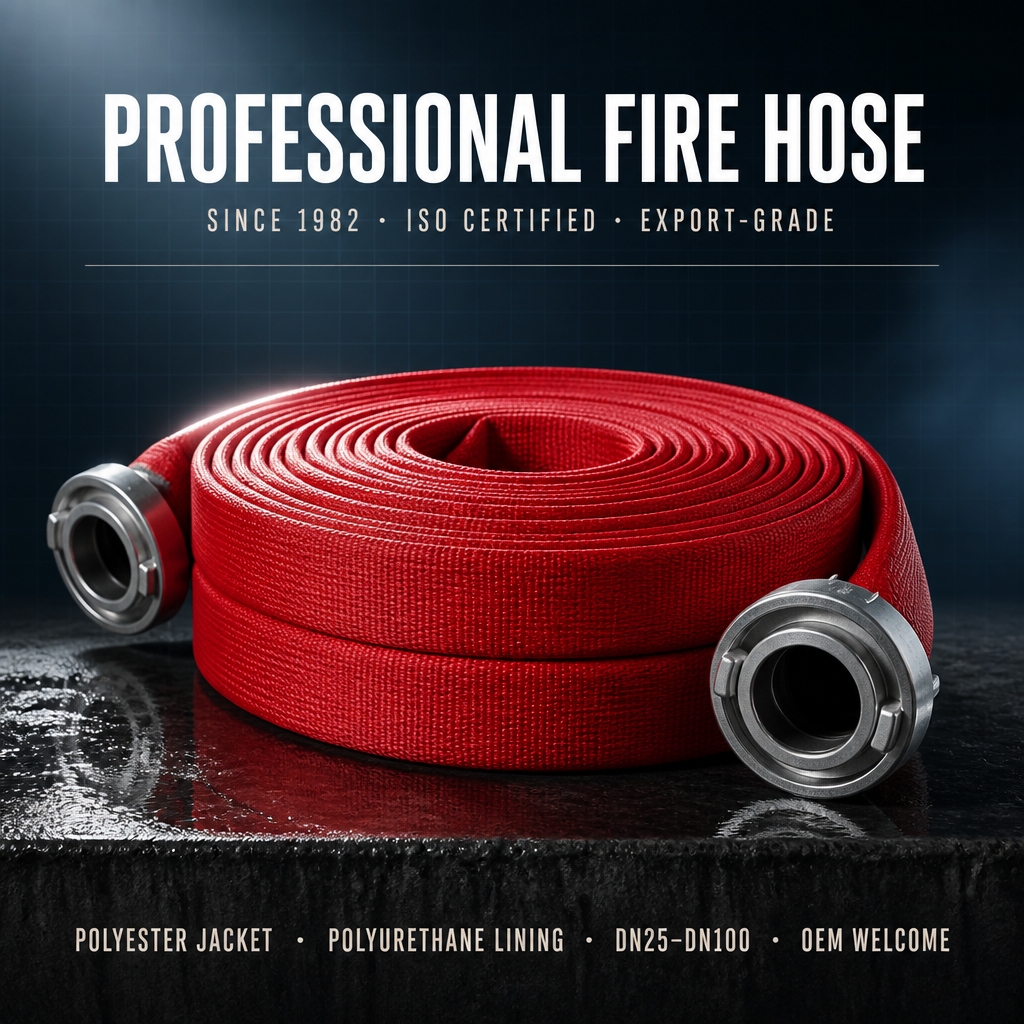
So, what are fire hoses made of? Three working layers: a liner, a woven jacket, and an outer cover. Each one does a specific job, and each one can be made from different materials depending on the application.
The Liner: What the Water Actually Touches
The liner is the innermost tube. It has to be watertight, chemically stable, and smooth enough to maintain good flow rate under pressure.
Rubber liners are the traditional choice. They handle heat well and seal tightly. The trade-off is weight, and in humid storage conditions they need more maintenance to avoid internal degradation.
PVC is the standard for budget-grade fire hoses. Lightweight and mold-resistant, it works fine for fixed indoor cabinet installations in temperate climates. The issue is cold weather — below around 5 degrees Celsius, PVC stiffens and becomes difficult to deploy quickly. Not what you want in an emergency.
TPU (thermoplastic polyurethane) is where most quality export orders have moved. Lighter than rubber, more flexible than PVC in cold temperatures, and smoother inside. For buyers sourcing for the Middle East, Southeast Asia, or marine applications, TPU-lined fire hose is worth the higher unit cost. It simply lasts longer under real conditions.
The Jacket: Single or Double?
The jacket is woven polyester — almost universally now, since cotton and linen have been phased out of serious fire hose material specs. What varies is how many layers of weave are applied.
A single jacket fire hose has one woven layer. Lighter and easier to handle, it works well for indoor standpipes and lighter commercial applications where the hose stays mostly in its cabinet.
A double jacket fire hose has two woven layers, which raises the burst pressure rating and adds significant abrasion resistance. For industrial sites, outdoor installations, or anywhere the fire hose sees regular heavy use, double jacket is the right specification. It is also the standard for most serious export orders.
Worth noting: two hoses can both be labeled double jacket fire hose and still perform differently depending on weave density and yarn quality. A tighter weave holds pressure more consistently. This is one area where the difference between a reliable supplier and a cut-rate one shows up directly in the product.
The Outer Cover
The cover handles physical punishment from the outside — abrasion, UV exposure, oil, and moisture.
For indoor cabinet fire hose installations, PVC cover is standard and adequate. For outdoor or vehicle-mounted applications, rubber or TPU cover is the better choice. TPU covers are lighter than rubber, stay flexible in cold weather, and hold their appearance better over time. Since the cover is the first thing a buyer or end user sees, a hose that looks clean after storage reflects well on the product.
Matching Fire Hose Material to the Application
Most buyers do not need to specify every layer independently. They need to match the fire hose material to the actual use environment.
Indoor commercial buildings: polyester double jacket, PVC liner, PVC cover. Solid performance, competitive price.
Industrial, outdoor, or demanding export markets: polyester double jacket, TPU liner, TPU cover. Higher unit cost, but better service life and certification compliance.
Cold-climate regions: avoid PVC liner. The stiffness issue is real and it comes back as a complaint.
Post time: Sep-14-2026