


When laying out fire protection systems or ordering replacement equipment for a commercial facility, selecting the right fire hose length is every bit as critical as choosing the internal bore diameter. Yet many buyers treat length as an afterthought, simply ordering whatever rolled up neatly in the last catalogue.
That is a mistake.
Connecting the wrong line length does more than create excess clutter on the floor. It drastically alters hydraulic pump demand, increases friction loss, and makes handling unnecessarily exhausting for responding crews.
Whether you need a modular 50 ft fire hose (15 meters) or an extended 100 ft fire hose (30 meters) depends entirely on how water moves through your building. Here is a practical engineering guide to selecting the right fire hose section for your project.
Standard Fire Hose Length Options
In international municipal and industrial supply, layflat firefighting hose sections are manufactured in standard cut lengths:
- 50 ft (15 meters). The universal standard across North America for municipal structural firefighting and cross-lay attack beds.
- 66 ft to 75 ft (20 to 23 meters). Common in European fire brigades and marine shipboard fire lockers.
- 100 ft (30 meters). The standard worldwide for commercial building standpipe cabinets, industrial washdown reels, and agricultural transfer lines.
A single continuous line might sound convenient on paper. Why bother with couplings when one long line reaches the whole corridor? In real firefighting, the physics tell a very different story.
Why 50 ft Fire Hose Sections Dominate Municipal Attack Lines
Frontline structural firefighting demands rapid maneuvering through narrow stairwells, sharp hallway corners, and cluttered doorways.
A 50 ft fire hose section offers three critical operational advantages:
1. Maneuverability and Weight
A charged 50 ft fire hose filled with water weighs roughly 80 to 110 pounds depending on diameter. A crew can advance that weight up a stairwell relatively quickly. If you doubled that continuous length to 100 ft without intermediate couplings, moving a charged line around furniture becomes nearly impossible for a two-person team. Heavy lines slow crews down.
2. Kink Management
Every extra foot of unused hose lying on the floor creates a potential kink point. If a line kinks behind a closed door, water flow drops instantly. Modular 50-foot sections allow crews to flake out only what they actually need before charging the line.
3. Fast Damage Replacement
If broken glass or burning debris punctures an attack line during an operation, replacing a single 50 ft fire hose section takes thirty seconds. You uncouple the damaged segment, insert a spare 50-foot coil, and resume water flow. Simple as that. If you deployed a single 100-foot piece, you would have to shut down the entire advance and drag out the whole run.
When a 100 ft Fire Hose Is the Superior Choice
While attack teams favor modular 50-foot sections, an unbroken 100 ft fire hose is the undisputed king of indoor fixed systems.
Inside commercial office towers, hotels, and manufacturing warehouses, fire cabinets house stationary occupant-use lines. NFPA 14 standards specify that an indoor standpipe station must provide enough reach to cover every corner of the floor area without requiring occupants to connect loose hardware in the dark.
For these fixed stations, installing a 100 ft fire hose ensures:
- Zero Coupling Snags. When office workers pull a line off a swinging rack, intermediate metal couplings can catch on cabinet frames or door jams. An unbroken 100-foot piece glides smoothly across the corridor without catching.
- Fewer Leak Points. Every coupling joint is a potential pressure leak. Eliminating intermediate joints keeps architectural walls clean and ensures full line pressure reaches the nozzle.
- Full Area Coverage. A 100-foot line combined with a standard 30-foot nozzle stream provides 130 feet of effective reach, easily covering expansive warehouse bays.
The Hydraulic Penalty: Understanding Friction Loss
Water running through the interior of any firefighting hose creates friction against the inner lining. That resistance strips away pressure before water ever reaches the nozzle tip.
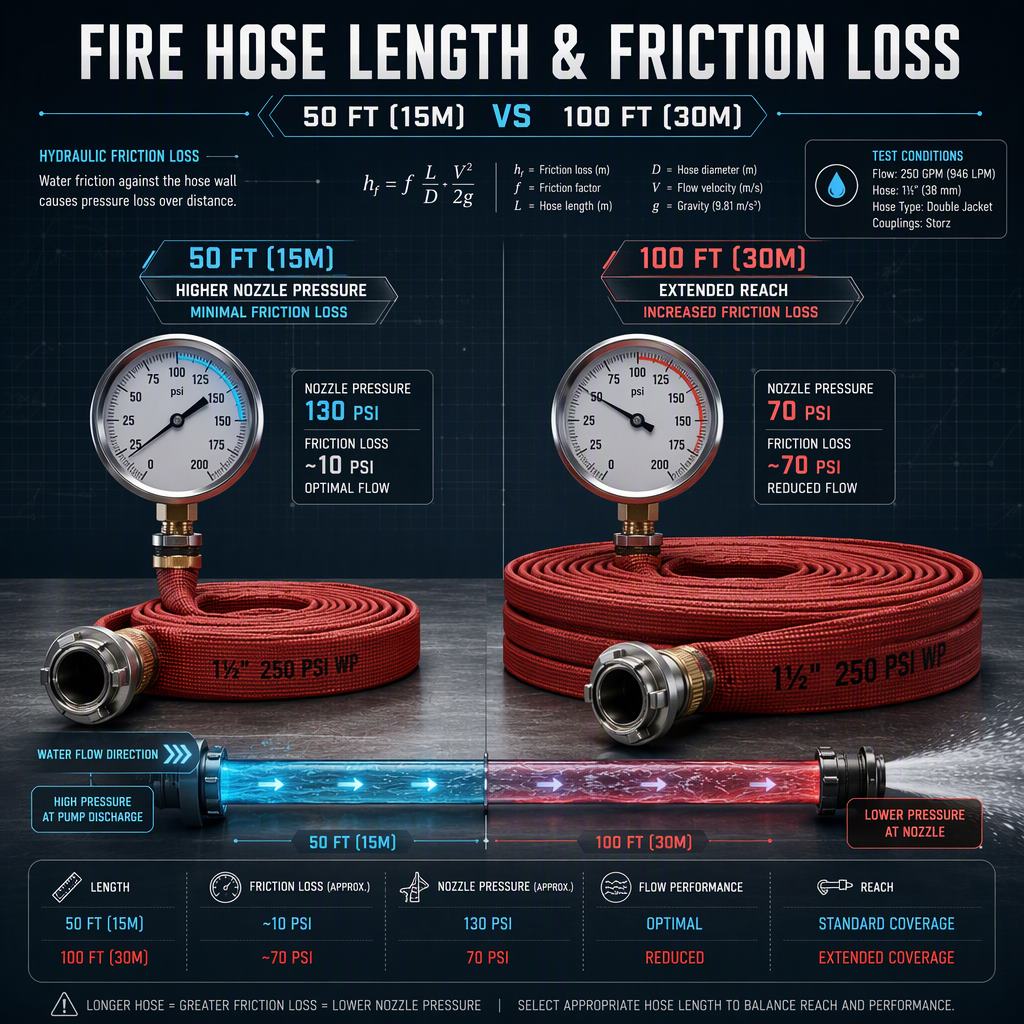
This friction loss rule is simple: friction loss is directly proportional to fire hose length.
If your pump discharges water through a 50 ft line at 10 psi of friction loss, stretching that run to 100 ft doubles the friction loss to 20 psi at the exact same flow rate. If you stretch a 200-foot relay line, friction loss quadruples. Simple physics.
As discussed in our guide to fire hose sizes, water velocity and internal diameter determine baseline loss. But length is the multiplier. If you specify an overly long fire hose length for your facility, your booster pumps will struggle to maintain minimum nozzle discharge pressure.
Always balance your total layout distance against your fire hose working pressure ratings to ensure adequate hydraulic delivery. Never compromise here.
Sourcing Checklist: How to Specify Length
Before placing an order for commercial firefighting hose inventory, verify these four points:
- Is the application a mobile attack line (requiring modular 50 ft fire hose sections) or a stationary cabinet (requiring continuous 100 ft fire hose coils)?
- Does your architectural floor plan leave blind spots that a standard 100-foot layout cannot cover?
- Have your mechanical engineers calculated total friction loss across the maximum expected layout distance?
- Plan ahead. Are your storage racks sized to accommodate the packed coil diameter of the specified fire hose length?
Selecting the correct fire hose length up front prevents expensive field modifications and ensures rapid, dependable deployment during an emergency.
Post time: Nov-02-2026