


Walk into most commercial buildings and you will find a fire hose cabinet on the wall. Open it and there is a hose, coiled and ready. Most people never think about why that particular hose is that particular size. Size is not random. It gets specified for a reason, and if you are ever on the buying side of that decision, getting fire hose sizes right matters more than almost anything else on the spec sheet.
How Fire Hose Sizes Are Measured
The size of a fire hose refers to its internal diameter — the actual opening the water flows through. Not the outside. The bore.
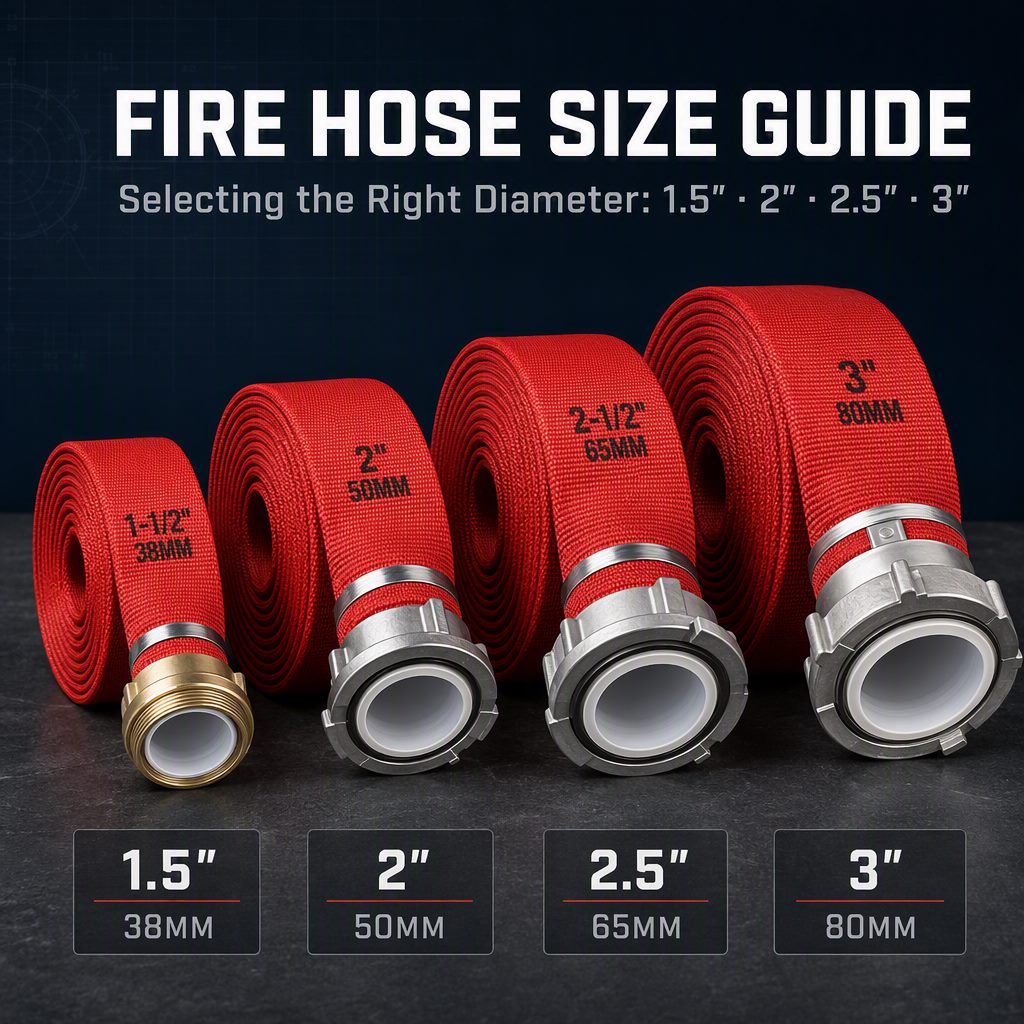
You will see this expressed in inches or millimeters depending on where you are in the world. Metric markets use DN (nominal diameter): DN40, DN50, DN65, DN80, DN100. If you are working with imperial specs, those translate to roughly 1.5, 2, 2.5, 3, and 4 inches. When people talk about fire hose sizes in a procurement context, they mean the bore, because that is what determines flow rate and how the hose physically connects to hydrants, pumps, and nozzles at the job site.
The Sizes You Will Actually Encounter
DN50 gets used in a lot of indoor standpipe systems — residential blocks, offices, the kind of installation that gets inspected once a year and hopefully never used. It is light enough for most people to handle, flows enough water for a contained interior fire, and meets most building code requirements for occupancy types that are not especially high-hazard. If you are speccing a standard commercial building, DN50 is a reasonable starting point.
DN65 is different. This is the size that shows up in warehouses, factories, industrial facilities, and the bulk of serious export orders. There is a reason for that. It balances flow volume and manageability in a way that works across a wide range of scenarios. When someone asks for a “standard firefighting hose” without giving more detail, DN65 at 13 Bar is almost always what they actually mean. It is the default firefighting hose size for a reason.
DN80 and DN100 are a different category. High flow, heavy construction, not something you pick up and run with through a building. These sizes serve fire truck supply lines, large-scale industrial suppression systems, and infrastructure projects where moving large water volumes quickly is the priority.
Why Fire Hose Diameter Affects More Than Just Flow
Here is something that catches buyers off guard the first time: the fire hose diameter has to match the thread standard and physical size of every fitting it connects to. Get the bore right and the coupling wrong and the fire hose physically cannot connect to the hydrant on site.
This matters most in export orders going to markets with different hydrant standards. A fire hose built with NST couplings will not connect to a BS336 hydrant without an adapter. The fire hose diameter spec is only half the story. The coupling has to match the local infrastructure, which means the local standard has to be confirmed before the order is placed.
Fire hose diameter also affects how pressure behaves in the system. Smaller bores handle high fire hose pressure more efficiently per unit of wall strength. As the diameter increases, the construction needs to be heavier to safely hold the same pressure rating. That is why large supply line hoses feel rigid and dense compared to the lighter attack hoses used by firefighters moving through a building — the engineering requirements are genuinely different.
Pressure Ratings and What They Mean
Two numbers. Working pressure is what the fire hose is designed to operate at continuously. Test pressure is higher — it is the pressure used during hydrostatic testing to verify there is a real safety margin above normal operating conditions.
For most commercial applications, 13 Bar working pressure is the standard specification. It covers typical municipal supply pressure with room to spare. Industrial facilities running dedicated fire pumps sometimes push higher, and the hose has to be rated to match.
One thing worth saying clearly: a higher fire hose pressure rating does not automatically make a product better for your application. If the system never operates near that pressure, you are paying for wall thickness and weight that adds nothing to real-world performance. The right pressure spec is the one that matches what the system actually delivers.
Choosing the Right Size
Most standard commercial and industrial projects: DN65, 13 Bar. That covers it.
Smaller buildings, lighter applications: DN50, 10 Bar is sensible and avoids overspecifying.
High-demand industrial or infrastructure work: DN80 or DN100, with the pressure rating confirmed against the pump specs before ordering.
The fire hose size decision flows from the flow requirement, which flows from the hazard classification of the space. Engineers work that out when they design the system. The hose spec is there to support the design — not to lead it, and not to be guessed at.
Post time: Sep-21-2026