


Outfitting commercial vessels, offshore drilling platforms, or ocean-going cargo ships with reliable safety gear requires navigating strict maritime regulations. While a factory on land can quickly call the local fire department during an emergency, an ocean vessel at sea is completely on its own.
When an engine room or cargo hold catches fire hundreds of nautical miles offshore, your shipboard firefighting system is your only line of defense. That is why choosing the right fire hose for marine service is strictly governed by international conventions.
Installing a standard municipal or commercial building line on a commercial vessel is not just dangerous. It will immediately trigger non-conformity flags during Port State Control inspections, risking costly vessel detentions.
Here is an engineering overview of what makes a compliant marine fire hose, how international maritime standards apply, and what ship chandlers must verify before ordering shipboard fire hose inventory.
The Harsh Realities of Shipboard Marine Firefighting
The open marine environment exposes shipboard gear to brutal conditions rarely seen in municipal fire stations:
- Salt Spray and Atmospheric Corrosion. Salt mist corrodes standard aluminum hardware, while salt encrustation degrades ordinary synthetic fabrics. A marine fire hose must resist continuous saline exposure.
- Aggressive Media Exposure. Onboard lines frequently drag through seawater, marine bunker fuel, hydraulic oils, and harsh deck detergents. If your fire hose absorbs oil, the jacket weakens rapidly.
- Intense Weather Extremes. Lines stored in weather-deck lockers must endure Arctic freezing followed by equatorial UV radiation. A quality fire hose must not harden or suffer ozone cracking under direct sunlight.
- Rough Steel Decks. Dragging lines across non-skid painted deck plating, diamond tread plates, and watertight coamings causes severe abrasive wear on any fire hose.
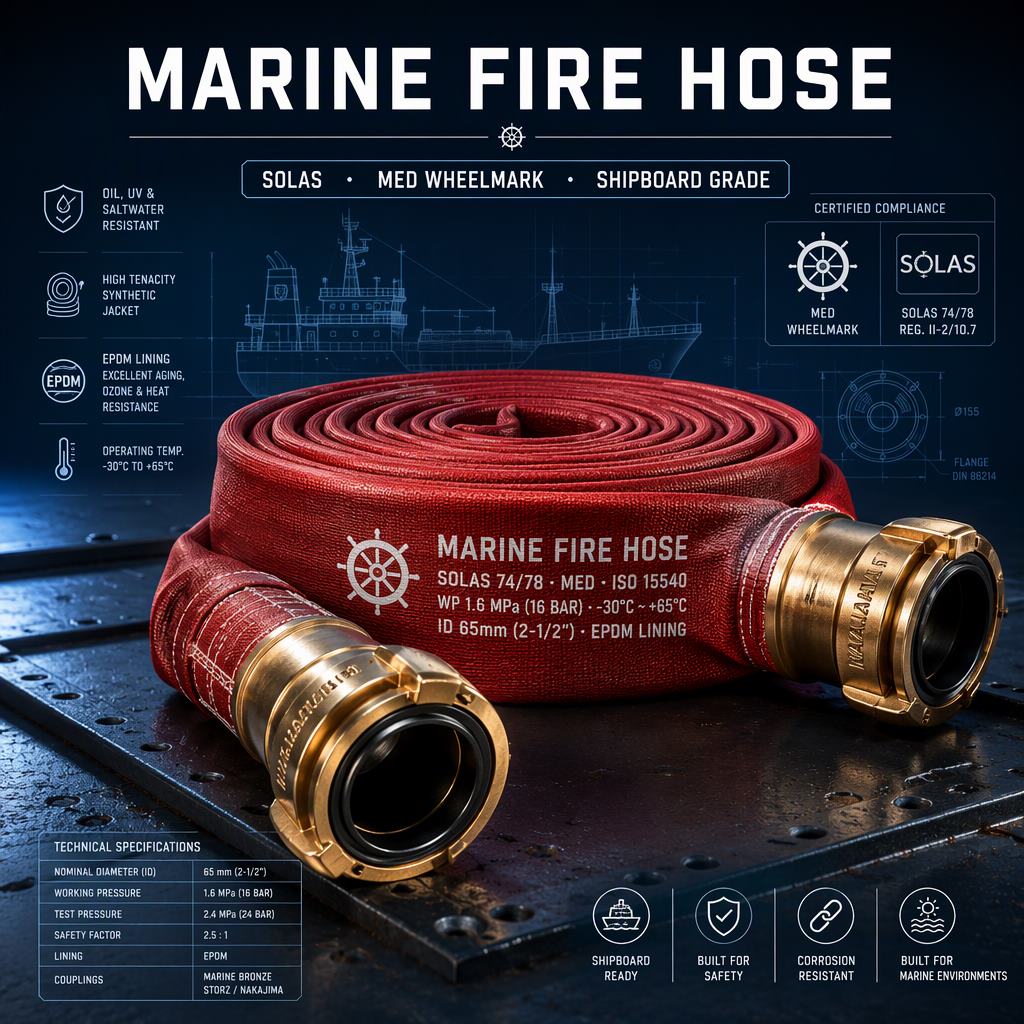
Because of these conditions, a durable marine fire hose must incorporate far tougher construction than standard municipal lines. Most maritime specifications mandate a heavy-duty synthetic rubber cover—frequently Nitrile rubber or high-grade EPDM—that completely encapsulates the woven jacket. This provides total resistance to sea salt, oil absorption, and mechanical abrasion. Choosing a rugged marine fire hose ensures your damage control party can advance without fear of burst failures.
Understanding SOLAS and MED Certification Standards
Any marine fire hose deployed on commercial vessels subject to international maritime conventions must hold proper type approvals.
1. SOLAS Convention (Chapter II-2)
The International Maritime Organization mandates fire safety regulations through the SOLAS convention. Regulation 10 specifically dictates shipboard fire mains, hydrants, and hoses:
- Every fire hose must be made of non-perishable material approved by the vessel administration.
- Each fire hose must have sufficient length to project a continuous jet of water to any required space on board.
- For ships over 1,000 gross tonnage, standard fire hose length on ship installations is typically 15 to 20 meters on open decks, and 10 to 15 meters inside machinery spaces. Adhering to the mandated fire hose length on ship layouts prevents dangerous kinks in narrow companionways.
2. MED Wheelmark Approval
For vessels flying the flag of an EU member state or calling at European ports, compliance with the Marine Equipment Directive is legally required. Equipment carrying the distinctive Wheelmark stamp proves the marine fire hose meets stringent maritime flame resistance, burst pressure, and aging standards. As outlined in our detailed analysis of fire hose standards compared, marine lines certified under EN 14540 undergo rigorous ozone and abrasion testing.
Major international classification societies such as DNV, Lloyd’s Register, Bureau Veritas, and ABS perform rigorous type approval testing on marine fire hose assemblies before issuing classification certificates. When sourcing a marine fire hose, verifying these certificates ensures full Port State Control compliance.
Standard Fire Hose Diameter on Ship Installations
Selecting the correct fire hose diameter on ship layouts requires balancing flow volume with physical handling limitations:
- 1.5 inch (DN40 / DN45). Standard for interior accommodation corridors, crew living quarters, and navigating bridges. A charged 1.5-inch line provides roughly 60 to 100 GPM, allowing a single mariner or a small two-person team to maneuver through watertight doors and steep ladderwells. As detailed in our practical guide to fire hose sizes, smaller lines minimize physical fatigue during prolonged internal containment. Evaluating the fire hose diameter on ship floorplans ensures your attack teams stay mobile.
- 2.0 inch (DN50) and 2.5 inch (DN65). Required on open weather decks, container holds, and vehicle decks on Ro-Ro ferries where maximum water volume is needed to cool structural steel and combat heavy cargo fires. A high-capacity fire hose provides the required volume to penetrate deep cargo stacks.
- Machinery Space Attack Lines. In the engine room, high water pressure must be matched with oil-resistant covers. As covered in our breakdown of fire hose pressure ratings, marine fire mains operate at continuous working pressures from 10 bar to 16 bar (150 to 230 psi), requiring high burst safety margins. Every ship fire hose installed near fuel pumps must handle severe thermal exposure without losing integrity.
Marine Fire Hose Coupling Standards: Beware the Port Mismatch
One of the biggest operational traps in maritime procurement is the coupling standard. Unlike municipal departments that stick to one national fitting, ocean-going vessels call at ports across different continents.
Common marine fire hose connections found on shipboards include:
- Storz Couplings. Widely used on German, Scandinavian, and European merchant fleets. The symmetrical sexless lugs allow instant quarter-turn locking under dark conditions.
- Nakajima Couplings. The predominant quick-connect standard across Japan, Korea, and Asian merchant shipping.
- BS 336 Instantaneous. Found extensively across British-built vessels, Commonwealth shipping lines, and Middle Eastern ports.
- Machino and Guillemin. Common in French and regional coastal waters.
- NH / NST Threaded. The standard across US-flagged vessels and North American naval fleets.
To prevent deadly connection failures during port operations, SOLAS requires every commercial vessel to carry an International Shore Connection. This universal flange coupling allows land-based fire departments anywhere in the world to connect their municipal fire hose directly to the ship fire main, regardless of thread or fitting type. Carrying a dedicated ship fire hose adapter set ensures complete operational readiness in foreign harbors.
Practical Maintenance and Storage on Board
Even the highest quality marine fire hose will fail if neglected on salty weather decks. Proper shipboard protocol requires:
- Dedicated Marine Fire Cabinets. Store lines in UV-stabilized fiberglass boxes with rubber door seals to protect your fire hose from salt spray and solar radiation.
- Freshwater Washdown After Use. Whenever a ship fire hose is deployed for drills or washdown using seawater, flush the interior and exterior thoroughly with fresh potable water before drying and rolling. Salt crystals left inside any fire hose cause abrasive wear over time. A clean fire hose lasts years longer in humid engine rooms.
- Annual Hydrostatic Testing. Marine safety regulations require annual visual inspections and periodic hydrostatic pressure testing of each ship fire hose to verify burst integrity. Never deploy an uninspected fire hose on an active cargo voyage.
Sourcing Checklist for Marine Buyers
When requesting quotes for vessel newbuilds or fleet replacement orders, your procurement team should verify:
- The required classification society approval (such as MED Wheelmark, DNV, LR, BV, or CCS).
- Internal diameter (DN40, DN50, DN65) and exact cut length (15m, 20m, 25m).
- Marine coupling standard (Storz, Nakajima, BS336, Machino, NH) and binding method (copper wire binding vs stainless steel crimped ferrule).
- Jacket and liner construction (all-synthetic double jacket with rubber liner vs heavy-duty through-the-weave extruded Nitrile rubber fire hose).
Selecting a certified marine fire hose up front guarantees smooth vessel inspections and dependable firefighting performance across every ocean voyage.
Post time: Nov-09-2026