


Buying a fire hose without understanding its pressure rating is a dangerous gamble. Under routine pumping operations, water pressure surges rapidly. If the jacket cannot handle the strain, the line bursts without warning. That puts crews in immediate danger and halts suppression on the spot.
Yet across commercial procurement, pressure terms get mixed up constantly. Suppliers throw around terms like service pressure, test pressure, and burst threshold, sometimes quoting the highest number just to make an ordinary line look like a heavy-duty product. That creates serious safety hazards on site. Never guess here.
Here is a straightforward guide to understanding fire hose pressure, how ratings translate into real-world fire hose psi requirements, and what to verify before ordering.
The Three Numbers Every Buyer Must Understand
When reviewing technical data sheets for any fire hose, you will encounter three distinct pressure ratings:
1. Fire Hose Working Pressure (Service Pressure)
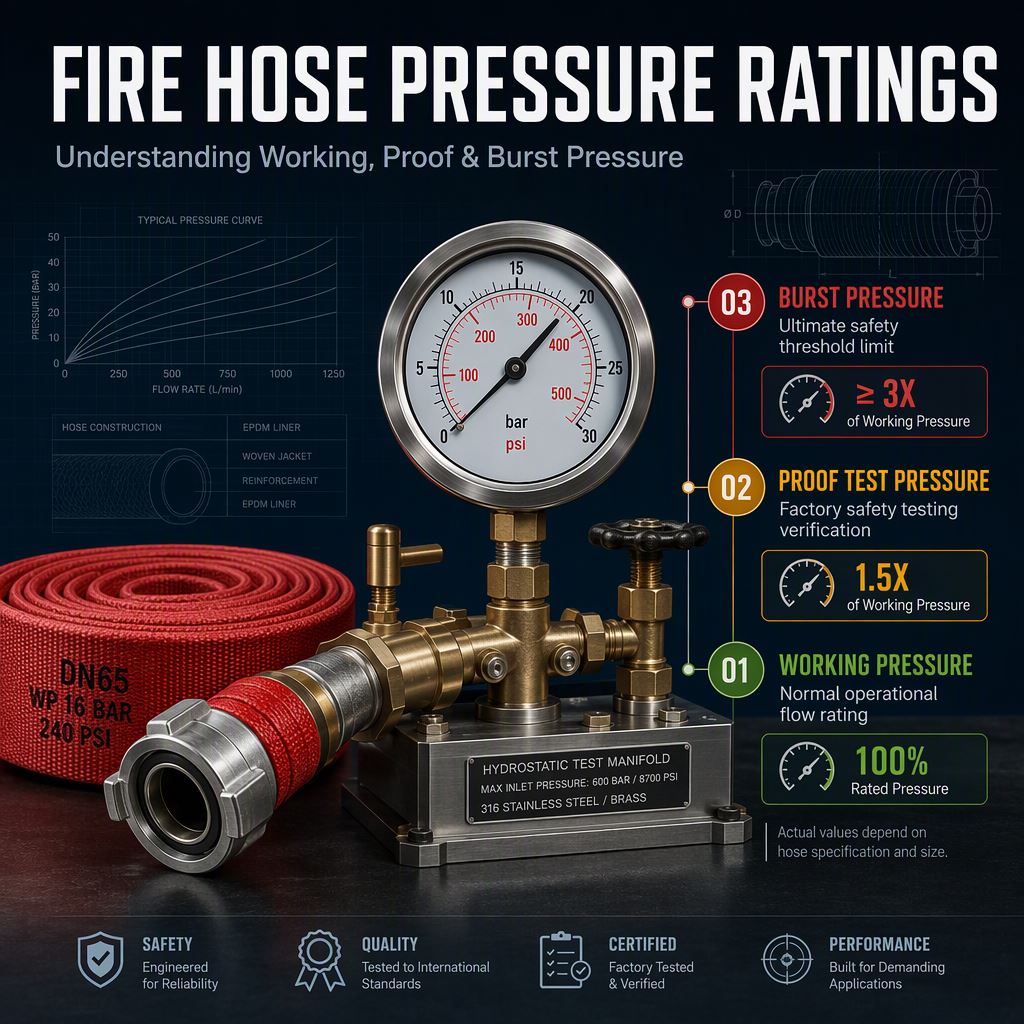
This is the single most important number for day-to-day operations. Fire hose working pressure represents the maximum continuous operating pressure the hose is designed to handle safely under normal service. For standard commercial and municipal lines, working pressure typically ranges from 150 psi up to 300 psi (1.0 to 2.0 MPa). If your pump discharge regularly hits 200 psi, your fire hose working pressure must comfortably exceed that threshold.
2. Proof Pressure (Test Pressure)
Proof pressure is a factory benchmark calibrated at exactly twice the rated working pressure. For example, a 250 psi line undergoes a factory hydrostatic acceptance test at 500 psi to prove the weave and couplings can withstand transient hydraulic spikes without weeping. It passes or it gets rejected.
3. Burst Pressure
Burst pressure is the ultimate structural failure threshold where the woven jacket mechanically ruptures. Standard fire codes require burst pressure to be at least three times the working pressure, meaning a 250 psi hose will have a minimum burst threshold of 750 psi.
This 3:1 safety margin exists for one reason: water hammer. When an operator snaps a nozzle bail shut, kinetic shock creates a violent hydraulic pressure spike traveling back down the line. Without that buffer, the jacket rips open.
How Much Fire Hose PSI Do You Actually Need?
Required fire hose pressure depends entirely on the application:
Building Occupant Lines (150 to 200 psi) Indoor fire cabinets intended for first-aid occupant use operate on lower pressures. A working fire hose psi rating of 150 to 200 psi is standard for these indoor reels.
Municipal Attack Lines (250 to 300 psi) Frontline firefighting crews demand double-jacket construction. These lines operate at 250 to 300 psi working pressure, giving crews the capability to pump massive water volumes up multi-story buildings without compromising hose integrity.
Industrial and High Pressure Fire Hose (400+ psi) Heavy chemical complexes, refineries, and wildland forestry teams routinely deploy specialized high pressure fire hose setups. These rugged lines withstand 400 to 500 psi continuous working pressure to drive water through extended overland relays. Big difference in duty cycle.
Why Routine Fire Hose Pressure Test Protocols Matter
A brand-new fire hose leaves the factory in peak condition, but heat, UV exposure, abrasive dragging, and chemical contact gradually degrade synthetic fibers over time.
That is why NFPA and international standards mandate an annual fire hose pressure test for every line kept in active inventory. During a standardized fire hose pressure test, technicians lay the line out flat, bleed all air, pressurize the jacket to its specified service test pressure, and hold it while inspecting for weeping or coupling slippage. Any line that fails is condemned immediately.
What to Confirm Before Ordering
Before signing off on an equipment order, always clarify these three details:
- Does the quoted specification state fire hose working pressure, or is the supplier quoting burst pressure?
- Does your pump capacity match the intended fire hose psi rating?
- Are your end couplings rated to match or exceed the hose pressure threshold?
Checking these pressure metrics up front guarantees your fire hose delivers reliable performance whenever crews charge the line under full pressure.
Post time: Oct-19-2026