


When importing fire protection equipment across borders, getting the dimensions right is only half the battle. If the line arrives without the exact certification required by local municipal code, the entire shipment gets rejected at the port or condemned during final building inspection. That is an expensive mistake nobody wants to explain to a client. Never assume compliance.
Fire protection regulations vary significantly by region. A municipal fire department in North America follows completely different testing rules than a commercial developer in Dubai or an industrial plant in Germany.
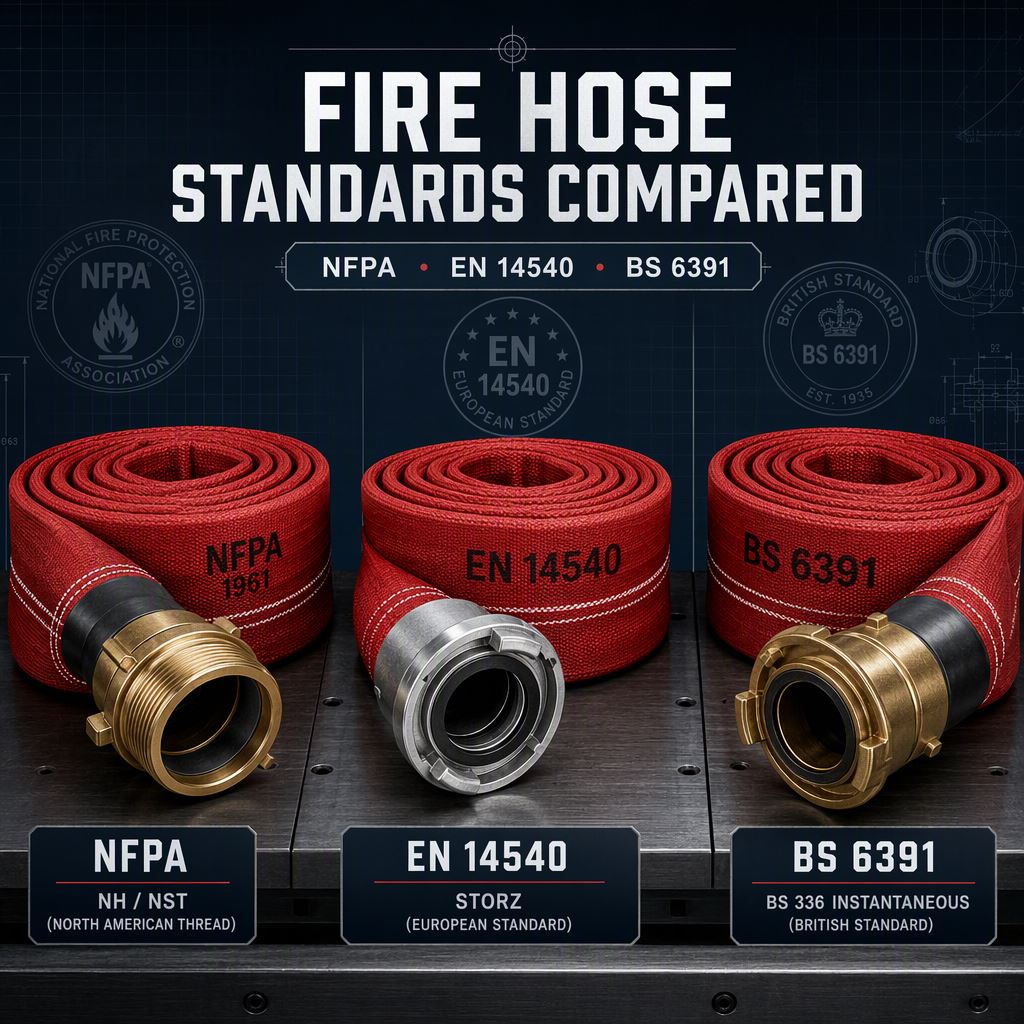
Understanding international fire hose standards ensures you order compliant gear every single time. Here is a practical breakdown of how NFPA, European (EN), and British (BS) specifications compare.
1. North American Standards: NFPA 1961, UL, and FM
Across the United States, Canada, and projects managed by American engineering firms worldwide, NFPA rules dictate project compliance.
The governing benchmark is NFPA 1961 (Standard on Fire Hose). Rather than dictating every tiny manufacturing step, an NFPA fire hose standard establishes rigorous minimum performance thresholds for design, materials, and proof testing.
Under NFPA guidelines, lines are categorized strictly by operational duty:
- Attack Lines. Built for interior structural firefighting where heat, abrasion, and hydraulic surges are relentless.
- Supply Lines (LDH). Large-diameter lines engineered to move massive volumes of water from hydrants to pumpers at lower operating pressures.
- Occupant-Use Lines. Lightweight single jacket lines designed specifically for indoor emergency wall cabinets.
In North American specifications, NFPA compliance is frequently paired with independent lab testing marks. An engineer will typically specify that your NFPA fire hose must carry UL Listing or FM Approval. These safety marks prove that third-party laboratory technicians verified the physical burst thresholds, kink resistance, and heat aging before the fire hose batch left the factory floor. Big difference in credibility.
2. European Standards: EN 14540 and CE Marking
If you supply projects across the European Union or international marine vessels operating under SOLAS rules, EN 14540 is the recognized fire hose standard.
EN 14540 covers non-percolating layflat firefighting hose assemblies for fixed fire protection systems. Unlike American codes that often separate the bare hose from the couplings, European standards look heavily at the complete fire hose assembly.
Key EN testing criteria include:
- Hydrostatic Burst Requirements. EN 14540 enforces strict burst-to-working pressure ratios. As detailed in our guide to fire hose pressure ratings, burst thresholds must exceed rated working pressure by at least three times.
- Ozone and Thermal Resistance. The inner rubber or TPU liner undergoes accelerated environmental aging to ensure the fire hose lining will not delaminate or crack after years of storage in unheated industrial warehouses.
- CE and Wheelmark Certification. For marine fire lockers, EN-compliant lines typically carry the MED Wheelmark stamp, verifying marine safety compliance. Simple as that.
3. British Standards: BS 6391 and the Kitemark
Across the UK, Commonwealth countries, and much of the Middle East, BS 6391 remains the dominant fire hose standard.
BS 6391 categorizes layflat firefighting hose lines into three distinct structural classes:
- Type 1 (Uncoated Jacket). Lightweight single-jacket construction designed primarily for low-frequency occupant use.
- Type 2 (Coated Jacket). The external woven polyester jacket receives an elastomeric coating to resist oil absorption and light abrasion.
- Type 3 (Through-the-Weave Rubber Covered). Heavy-duty synthetic rubber extruded through the woven reinforcement. These rugged lines are virtually impervious to oils, acids, and harsh chemicals, making them the standard choice for petrochemical refineries.
Whether your project calls for a single or double jacket fire hose, checking the required BS type ensures proper longevity on site.
How to Match Fire Hose Standards to Your Project
Before your procurement team issues a purchase order for any commercial firefighting hose shipment, verify three essential points:
1. Identify the Local Authority Having Jurisdiction (AHJ). Ask the project consultant directly whether local fire marshals enforce NFPA, EN, or British Standard compliance. Never guess.
2. Verify the Distinction Between Standard and Certification. A manufacturer can produce a fire hose “designed to meet” a standard, but that is not the same as holding third-party UL, FM, or BSI Kitemark certification. If your project specification requires certified goods, your buyers must request official certificate copies before releasing the deposit.
3. Check Coupling Compatibility. A compliant fire hose is useless if the couplings do not thread into site standpipes. Always match thread patterns alongside your fire hose standards verification.
Taking a few minutes to confirm these international fire hose standards protects your project schedule and guarantees compliant installation on site.
Post time: Oct-26-2026