


In standard commercial buildings, a fire sprinkler system waits quietly. Heat melts a tiny glass bulb on a single head, water discharges over the hot spot, and the rest of the floor stays dry. That localized response works well for offices. But in a petrochemical tank farm, a power transformer bay, or an aircraft hangar, localized discharge is never enough. Fire spreads across flammable liquids in seconds.
That is where a deluge valve comes in.
Instead of waiting for individual closed heads to open one by one, a complete deluge fire system floods an entire hazardous zone with water simultaneously. Knowing what is a deluge valve matters.
At its mechanical core, a deluge valve is a quick-opening differential control valve that separates pressurized municipal water from an unpressurized open-nozzle piping grid.
Unlike standard wet sprinkler systems where water sits right behind every closed bulb, piping downstream of a deluge valve system remains completely dry and open to atmospheric pressure. Every spray nozzle on the overhead grid is unsealed. There are no heat-sensitive glass bulbs. None at all.
When fire erupts, the deluge valve opens fully in a fraction of a second. Water surges through the riser, pressurizes the grid instantly, and discharges across every open nozzle at the exact same moment.
This simultaneous discharge drowns thermal radiation, prevents vapor flashover, and cools structural steel before heat weakens building supports.
The Working Principle: How the Deluge Valve System Triggers
Most modern industrial installations rely on a diaphragm-style deluge alarm valve because it eliminates mechanical latches that can seize up over years of standby.
Here is how pressure differential works inside the deluge valve body:
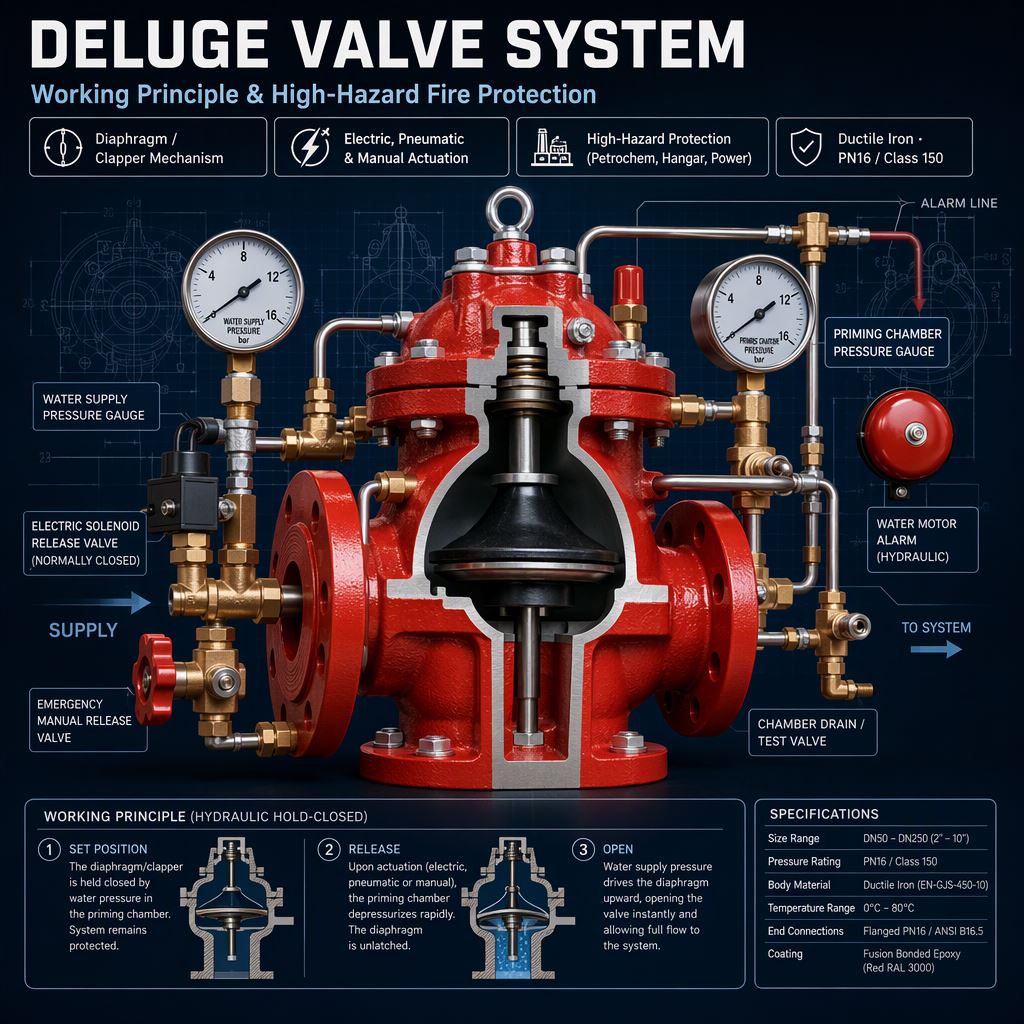
In standby mode, municipal water pressure enters beneath the valve clapper while routing through external trim into an upper diaphragm chamber. Because diaphragm surface area is roughly twice the clapper area, equal water pressure creates a net downward holding force. The deluge valve stays tightly shut. Simple physics.
Your deluge fire system relies on dedicated detection networks rather than sprinkler pipes to detect fire: electric optical flame detectors, pneumatic pilot lines, or hydraulic heat-sensing runs.
The moment detectors confirm a fire event, the pilot solenoid trips immediately and dumps upper chamber pressure. Water vents out. The downward holding force collapses on the spot. Upstream pressure pushes the clapper wide open, driving full water volume through the deluge valve into the open distribution network. Water also enters the alarm port of the deluge alarm valve, driving a mechanical water motor gong to alert facility operators.
Deluge Valve vs. Other Fire Protection Valves on Site
A high-hazard industrial facility never relies on a single valve type. When you design a complete plant network, you integrate specialized valves for different operational zones:
- Primary Deluge Protection. The heavy-duty deluge valve delivers high-velocity water spray across process equipment where fires spread faster than conventional sprinklers can contain.
- Manual Attack Lines. For perimeter defense, contractors install heavy-duty fire hydrant valve stations so responding industrial fire brigades have immediate access to high-flow hydrants.
- Pressure Management. When your main fire pumps kick in, integrating an inline pressure reducing valve prevents extreme downstream surges.
- Secondary Hose Defense. For initial occupant intervention before full deluge valve activation, dedicated fire hose system reels provide immediate targeted suppression.
Where Are Deluge Valve Systems Mandatory?
You will find a deluge valve system specified across environments where rapid flame spread is a certainty:
- Refineries and Chemical Plants. Distillation columns, pump manifolds, and LPG storage spheres require immediate flooding.
- Power Generation Facilities. High-voltage transformers demand massive water cooling.
- Aviation Hangars. Blanketing aircraft parking bays where jet fuel spills pose catastrophic flashover hazards.
- Marine Platforms. Wellheads and helidecks need reliable deluge valve protection against offshore blowouts.
Key Sourcing Considerations for Procurement
When you source equipment for a deluge fire system, never treat the valve as a generic commodity.
Verify three technical parameters before your team finalizes an order:
- Body Material. Ductile iron serves standard onshore plants, while cast bronze or nickel-aluminum bronze is essential for offshore seawater deluge valve service.
- Trim Configuration. Specify whether your release protocol requires electric solenoid actuation, wet pilot hydraulic actuation, or pneumatic dry pilot release.
- Certifications. Ensure your deluge alarm valve meets NFPA 13, UL listing, or FM approval standards for your project jurisdiction.
Taking the time to match valve specifications to site hazards guarantees your deluge valve operates reliably when seconds count. For detailed technical trim schematics or custom engineering assistance, you can always contact our engineering team directly.
Post time: Nov-23-2026