


You can buy the best fire hose on the market, rated for 20 Bar, fresh off the production line. But if the coupling attached to the end does not physically thread onto the hydrant waiting at the job site, you bought a rolled-up fabric tube that nobody can use. That is the blunt reality.
We see this mistake often in commercial procurement. A buyer confirms the working pressure, double-checks the diameter, and forgets to check what thread standard the local municipal system uses. Then the container arrives, and nothing screws together.
Here is a straightforward look at fire hose coupling types, how fire hose fittings connect, and what you need to verify before placing an order.
What Does a Fire Hose Coupling Actually Do?
At its simplest, a fire hose coupling is the metal hardware secured to both ends of a fire hose.
Its primary job is connecting the hose line to a water source like a standpipe valve, attaching a nozzle on the business end, or locking multiple lengths together when crews need extra reach across a large site.
Under load, that joint has to stay sealed. Completely. If a fire hose connector fails or leaks while operating under 15 Bar of pressure, you lose downstream flow immediately, and the crew loses their effective stream reach right when they need it most. That is why choosing the right fire hose fittings matters every bit as much as selecting the hose jacket itself.
Most hardware comes in cast brass or forged aluminum alloy. Brass weighs significantly more and costs extra up front, but it resists salt spray and harsh chemicals better than anything else on an offshore platform. Aluminum is much lighter. It saves crews from dragging unnecessary weight, which is why municipal departments specify aluminum for most everyday firefighting hose deployments.
The Three Main Coupling Systems
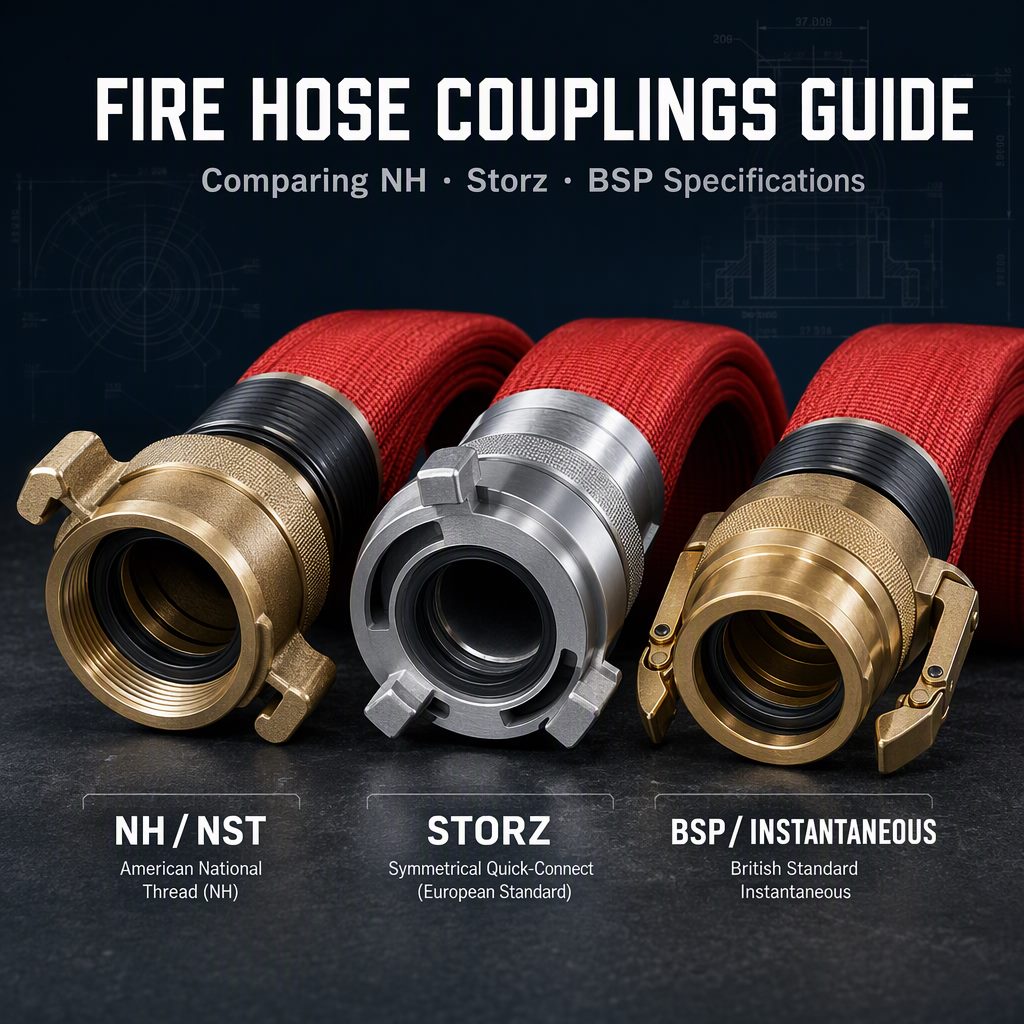
Fire hose coupling designs divide into two distinct categories: traditional threaded fittings and genderless quick-connects. Where your project sits on a map determines which one you need.
1. NH / NST (National Standard Thread)
This is the dominant standard across North America. It is a threaded fire hose connector built with distinct male and female ends, where the female side carries an internal swivel ring with raised rocker lugs so an installer can tighten it by hand or finish it with a spanner wrench. If the project specification references NFPA rules, NH is what belongs on your fire hose.
2. Storz Coupling (Sexless Quick-Connect)
Designed in Germany and used heavily across Europe and international marine fleets. Unlike threaded hardware, every Storz coupling is completely identical. There are no male or female halves to fumble with in the dark. You simply press two identical heads together face-to-face and twist them a quarter-turn until the lugs lock. Done. Connections happen in under three seconds. If you supply marine vessels or European plants, you will encounter Storz coupling hardware on almost every fire hose locker.
3. British Standard (BS 336 / Instantaneous)
Standard throughout the UK and common across Middle Eastern construction projects. It uses an instantaneous push-in latching mechanism on 2.5-inch lines, where two spring-loaded clips snap into a grooved male adaptor automatically the moment you push the fittings together.
Why Mismatched Fire Hose Fittings Cause Headaches
Different regions never settled on a universal standard. An NH threaded fire hose coupling will never screw into a British Standard outlet, and forcing them together strips the threads and ruins the fitting.
Before placing an order for any fire hose batch, always verify three points:
- The internal bore diameter of the fire hose (DN50 or DN65).
- The exact coupling standard (NH, Storz, or BS 336 instantaneous).
- The metal specification (naval brass or forged aluminum).
If you are ever uncertain about what is already installed on the project site, have the local site supervisor take a clear photo of the existing hydrant valve before you finalize your fire hose order. That quick check saves weeks of freight delays down the road.
Post time: Sep-28-2026